Posted on November 3, 2026
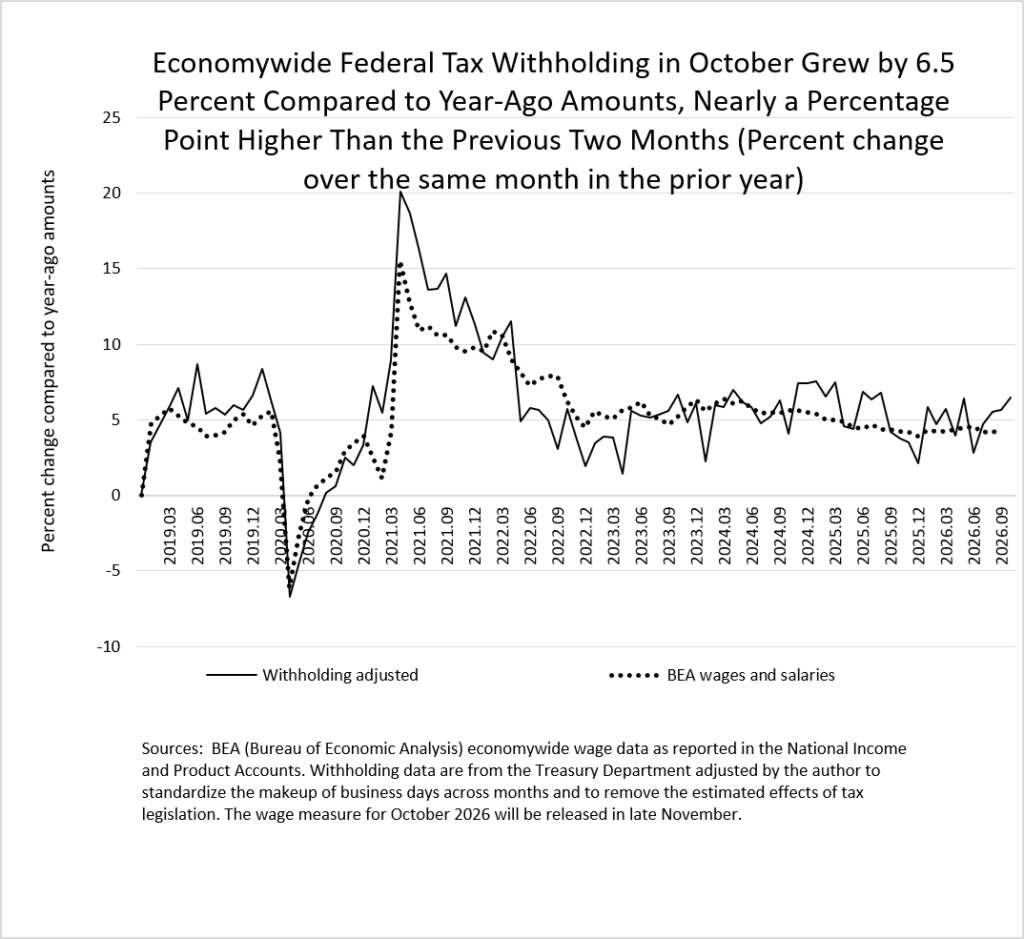
In October, we observed another move up in growth of federal tax withholding–that is, the overall amounts of income and payroll taxes that employers withheld from workers’ paychecks and remitted to the Treasury Department as soon as the day after the workers were paid (see the chart below). We estimate that withholding growth in October was 6.5 percent on a year-over-year basis (comparing the amounts in October 2026 to those from October of a year ago). That is about one percentage point higher than the growth that we estimated for both August and September, and the highest since the summer of 2025 (albeit just a tick higher than growth in May 2026). Withholding growth in recent months has been faster than the rate of inflation plus employment growth, plus a small increase in average income tax rates from economic growth. Therefore, we estimate that inflation-adjusted economywide wages and salaries per worker are growing. Note that our measure of withholding growth is adjusted to remove the estimated effects of federal tax legislation enacted last year, which we estimate reduced this year’s withholding growth by about 0.6 percentage points. Removing those effects allows us to measure withholding growth on a constant law basis, which should more closely link with economywide wage and salary growth.
Growth in wages and salaries in recent months as measured by the National Income and Product Accounts (NIPAs) has been lagging well behind our measure of withholding growth. Some of that is to be expected in a growing economy as average tax rates rise from graduated income tax rates, boosting withholding relative to wages and salaries. But wages and salaries are lagging more than we would expect. We don’t yet know if that indicates eventual revisions to the NIPA wage and salary data, substantial wage distributional shifts, or some mismeasurement by us of withholding growth on a constant law basis.