
This website is dedicated to tracking real-time U.S. federal tax collections. We track income and payroll taxes that are withheld from paychecks, along with their relationship to the U.S. economy, especially wages and salaries. We also track individual refunds and payments during the tax filing season. We track other data releases, such as estimated payments of income taxes and different measures of aggregate wages in the economy.
The main data innovation is that we have developed a filtering technique in order to assess the extremely volatile daily tax withholding data. Properly assessed, withholding tax receipts are a rich source of economic data because they are available in almost real time: the largest firms remit their withholding to the U.S. Treasury Department the day after they pay their employees, and then the Treasury reports the total amount paid the day after that. In addition, total withholding taxes paid correlate well with different measures of economywide wages and salaries that are available later. And it is possible that the daily withholding data provide an early indication of movements in the components of economywide wages: employment, average hourly wages, and average hours worked per week. We provide those daily for the past month at the bottom of this page.
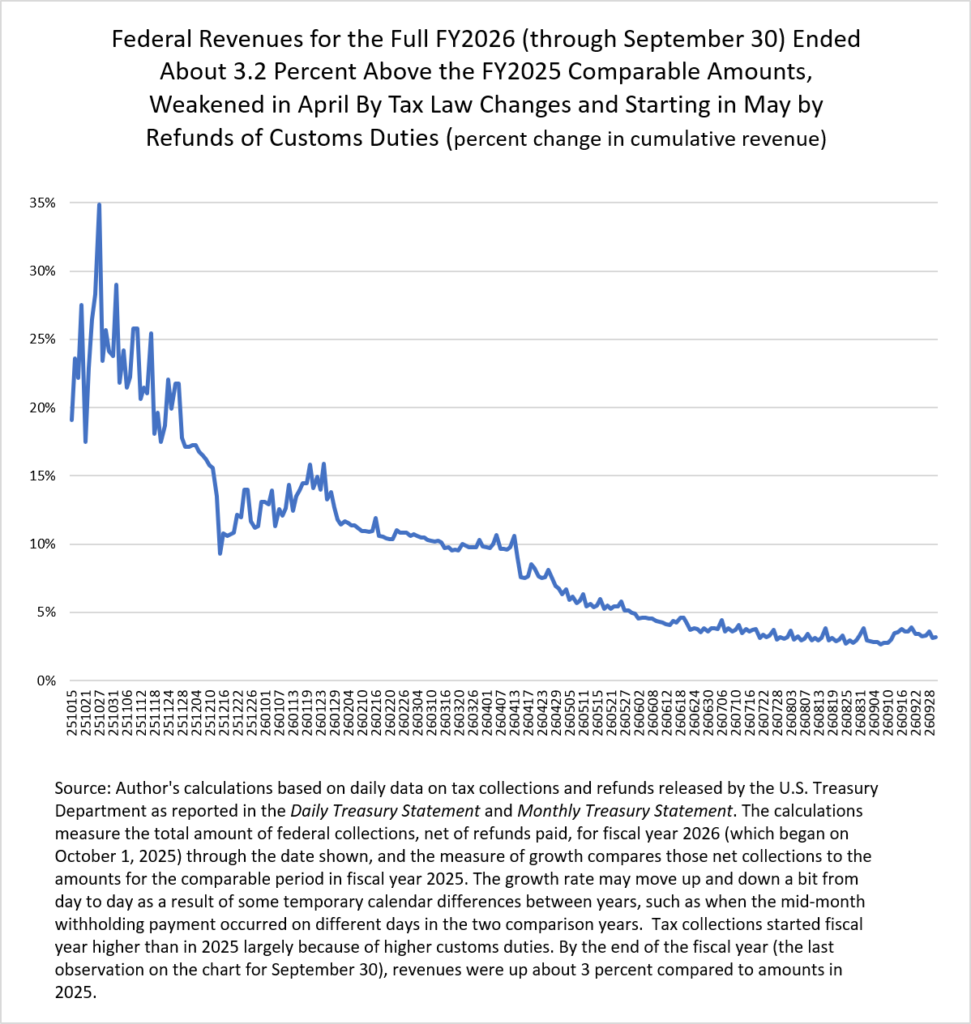
We are tracking, on a daily basis, total federal revenues for the 2026 fiscal year. Based on information from the Treasury Department, we can estimate how federal revenues for the current fiscal year-to-date compare to those for last year through the same point in the year. The estimated percentage increase or decrease in revenues for the fiscal year, compared to last year’s amounts, are provided in the chart below. The last data point illustrates the percentage increase or decrease in revenues for the fiscal year though the latest date available, compared to the amount for the same period last year.
Summary of Recent Developments
- We tracked total federal revenues on a daily basis through fiscal year 2026 (which began on October 1, 2025, and ended on September 30, 2026). Total revenues for the full fiscal year (that is, through September 30) were about 3.2 percent higher than the amounts for all of 2025, which matched our estimate based on the Daily Treasury Statements through September 30. (See the chart below for the progression of growth through the course of fiscal year 2026.) Payments by both individuals and corporations in September of quarterly estimated payments grew sharply, which pushed up growth for the full year by a half to a full percentage point or so. However, from May through September, the Treasury Department paid out about $135 billion in customs duty refunds, compared to about $3 billion in the same period of 2025. Those refunds, which resulted from the Supreme Court decision invalidating many of the Administration's earlier tariff increases, contributed to slowing overall federal revenue growth from May through September. Early in fiscal year 2026, revenues were instead boosted well above year-ago amounts by large additions in customs duties. But declines in corporate quarterly income tax payments in mid-December and again in mid-April, probably largely due to legislation enacted last year that provided corporate tax cuts, caused overall revenue growth for the fiscal year to fall at those points but remain positive. Those tax law changes also boosted individual income tax refunds this past filing season well above the 2025 amounts, and also kept individual income tax payments with timely-filed returns from growing in April. And then the customs duty refunds began in earnest in May.
- We estimate that September saw steady, moderate growth in economywide federal tax withholding amounts. Specifically, we estimate that withholding growth was about 5.6 percent on a year-over-year basis, about the same as the 5.5 percent year-over-year growth in August (see post of October 1). That growth is faster than the rate of inflation plus employment growth, plus a small amount of increase in average income tax rates from economic growth, so it is consistent with inflation-adjusted, economywide wages per worker that are growing at a moderate pace.
- Payments with individual income tax filings in the 2026 filing season (for tax year 2025) were down about 1 percent from the previous year's amounts (see the chart below). We had expected single-digit growth in payments with tax returns, so the small decline is a slightly weaker result than we expected. We believe that two main effects largely netted out: an increase in stock market prices and Wall Street bonuses in 2025 that would normally boost growth in payments with tax returns; and tax cuts enacted in the 2025 reconciliation legislation that were largely not reflected in tax withholding and quarterly estimated payments last year and thus boosted refunds and lowered payments during this tax filing season.
Federal withholding collections can be tracked over recent days, months, and years (see three charts below). The chart on withholding year-over-year growth in recent days is updated daily around 4:15pm ET, shortly after the 4:00pm release of the Daily Treasury Statement. Generally the withholding data for about half or more of the business days in a month can be filtered appropriately to generate estimates of withholding growth. (See the Updating Schedule page for when the next updated daily data point will be available.) Withholding in recent years, when adjusted for the effects of certain major tax law changes, has had a relatively close relationship with total U.S. wages and salaries as measured in the National Income and Product Accounts (see third chart below). Withholding generally has a comparable or closer relationship to the NIPA wage data than do the wage data releases by the Bureau of Labor Statistics that are available after the withholding data (see Usefulness of Tax Withholding in Estimating Wage Growth and Revisions). The withholding tax data can also often predict NIPA wage revisions.
Source: Author’s calculations based on data from the U.S. Treasury Department’s Daily Treasury Statements.
For the chart on withholding in recent months, the adjusted measure removes the estimated effects of recent law changes that affect withholding but not wages. That allows the measure of withholding growth to provide a better gauge of growth in wages and salaries. The unadjusted measure does not remove those effects from law changes and instead measures the raw percentage change in withholding.
For the chart on withholding in recent days, the measure is adjusted to remove the estimated effects of recent law changes that affect withholding but not wages.
To see when the next daily observation will be available, click here. For downloadable data for chart of recent days, click here.
Sources: For withholding growth, author’s calculations based on data from the U.S. Treasury Department’s Daily Treasury Statements, adjusted to remove the effects of estimated tax law changes for certain periods mainly before January 2019. Also, beginning at the end of March 2020, the data are adjusted for estimated effects of delays allowed for employers to remit their share of Social Security payroll taxes through calendar year 2020 and for the estimated effects of certain tax credits for the employer share of Social Security taxes. For wage and salary growth, data from the Bureau of Economic Analysis, National Income and Product Accounts, Table 1.12, latest monthly release.
Note: The adjustments to withholding growth to reflect major tax law changes are the following: March 2009 to February 2010 (+2.8%); March 2010 to December 2010 (-0.5%); January 2011 to December 2011 (+3.4%); mid-January 2013 to mid-January 2014 (-8.0%); mid-January 2018 to mid-January 2019 (+7.0%); late March 2020 to December 2020 (+7.0%); January 2021 to late March 2021 (+1.4%), late March 2021 to December 2021 (-6% to -8%); January 2022 through September 2022 (about -1.5%), and starting in February 2026 (+0.6%). The adjustments are phased in over several weeks to correspond with gradually-adjusting withholding. The adjustments are from the author’s calculations based on publicly-available information available from the Tax Policy Center, the Congressional Joint Committee on Taxation, and the Congressional Budget Office.
Email Booth Financial Consulting LLC at mark@boothconsult.com or mark@taxtracking.com
Posts
- October 2026
- September 2026
- August 2026
- July 2026
- June 2026
- May 2026
- April 2026
- March 2026
- February 2026
- January 2026
- December 2025
- November 2025
- October 2025
- September 2025
- August 2025
- July 2025
- June 2025
- May 2025
- April 2025
- March 2025
- February 2025
- January 2025
- December 2024
- October 2024
- September 2024
- August 2024
- July 2024
- June 2024
- May 2024
- April 2024
- March 2024
- February 2024
- January 2024
- December 2023
- November 2023
- October 2023
- August 2023
- July 2023
- May 2023
- April 2023
- March 2023
- February 2023
- January 2023
- December 2022
- November 2022
- October 2022
- September 2022
- August 2022
- July 2022
- June 2022
- May 2022
- April 2022
- March 2022
- February 2022
- January 2022
- December 2021
- November 2021
- October 2021
- September 2021
- August 2021
- July 2021
- June 2021
- May 2021
- April 2021
- March 2021
- February 2021
- January 2021
- December 2020
- November 2020
- October 2020
- September 2020
- August 2020
- July 2020
- June 2020
- May 2020
- April 2020
- March 2020
- February 2020
- January 2020