Posted on July 28, 2025
Summary
- Customs duties have soared as a result of the President imposing a wide variety of new tariffs (that is, taxes on imports) in the form of general, country-specific, and good-specific tariffs. Customs duties for the past two months have run at an annual rate of about $325 billion, about four times the 2024 amount, and which if sustained would move them from the fifth largest category of federal revenues to the fourth largest.
- Tariff rates can largely be adjusted by the Administration without Congressional action, albeit with court cases in progress contesting the degree of Presidential discretion. The Administration has imposed, modified, and delayed numerous elements of tariff policy, with discussions ongoing with trading partners, making it impossible to know what rates will apply in future months.
- Customs duties are paid to the Treasury Department by the domestic importer, but the effect of the duties can either be passed along to consumers in higher prices, absorbed by the U.S. importer as lower profits, or absorbed by the foreign producer as lower profits. We believe it is clear that in general tariffs are substantially passed through to consumers as higher prices, although the amount depends on factors such as how many substitutes are available to consumers and the degree to which substitute markets in other countries are available to the producer.
The Administration’s new tariffs are a complicated, dizzying array of general, country-specific, and product-specific duties that are often changing or being delayed. I won’t go into the different rates, and there are good tariff trackers available, such as from the Tax Foundation and Yale Budget Lab.
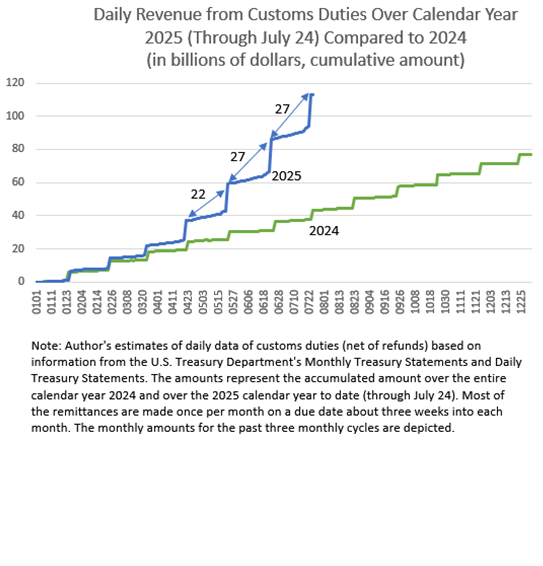
What is not complicated is observing the rapid surge in customs duties in recent months. After averaging about $7 billion per month in 2024, federal collections from customs duties have soared to about $27 billion per month in both June and July of this year (see chart below). Based on recent import data from the Census Bureau and National Income and Product Accounts, we think only a small portion of the increase in customs duties represents front loading of imports in anticipation of even larger duty rates in the future; it’s the higher duty rates by and large. In any event, the importer pays customs duties to the Treasury largely on one day each month, usually the 15th business day, for duties accumulated during the prior calendar month. (Thus, the amounts collected largely represent activity during the prior month.) The amounts are reported in the Daily Treasury Statement a day or two after the payment due date. Last week we observed the large amounts reported for July 23.
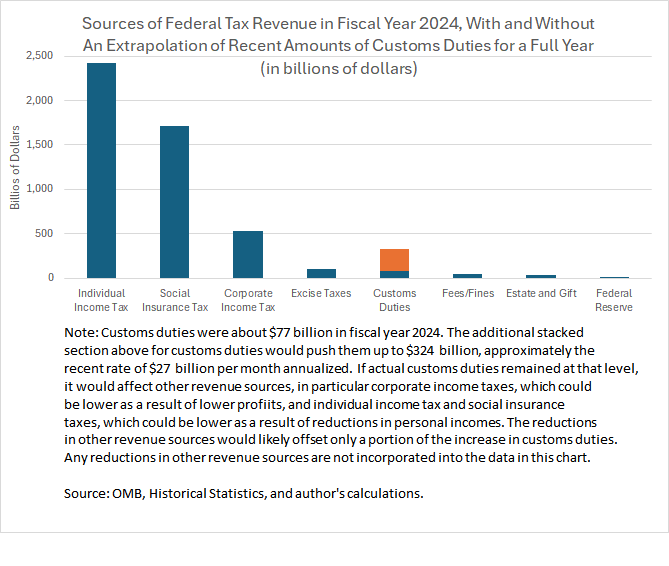
If the amount of customs duties of the past two months were to continue–and that’s a big “if” considering the discretion the Administration has to quickly adjust the rates, and also considering the court cases working their way through the judiciary contesting the degree of that discretion–then duties would quadruple to about $325 billion for an entire year. That would move them from being the 5th largest federal revenue source in 2024 to the 4th largest going forward (see the second chart below). The revenue would still be less than that from corporate income taxes, the 3rd largest revenue source, and far behind individual income taxes and social insurance (mainly Social Security and Medicare) taxes. Indeed, those other income-based tax sources would likely be somewhat smaller with customs duties running at that high rate, but we expect the net effect of the new tariffs would easily be to increase overall federal revenue. With federal deficits currently approaching $2 trillion annually, the added customs duties for a full year (over $240 billion) would offset about one-eighth of the deficit, and less including any reductions in other federal revenues or if the additional duties were spent by the federal government in some way.
The effects of higher customs duties on the economy are even more complicated than the many rates applied to different types of imports. We believe that it is clear, however, that generally tariffs are substantially passed through as higher consumer prices. Different studies of the tariffs imposed in the 2018-2019 period concluded that they largely or totally were passed through to consumers. However, the characteristics of demand and supply help determine how much might also be absorbed by the domestic importer as lower profits or by the foreign producer as lower profits. If the good is a necessity or one with few domestic substitutes, or if the domestic supply is not easily increased, then that would tend to allow the duties to be passed along as higher consumer prices. Likewise, if a foreign producer has alternative markets in other countries, then that would also tend to allow the producers to pass the higher duties along to U.S. consumers.
And there are many more macroeconomic and distributional effects of tariffs far beyond the scope here.
We will continue to monitor the size of the customs duty payments.