Posted on January 7, 2026
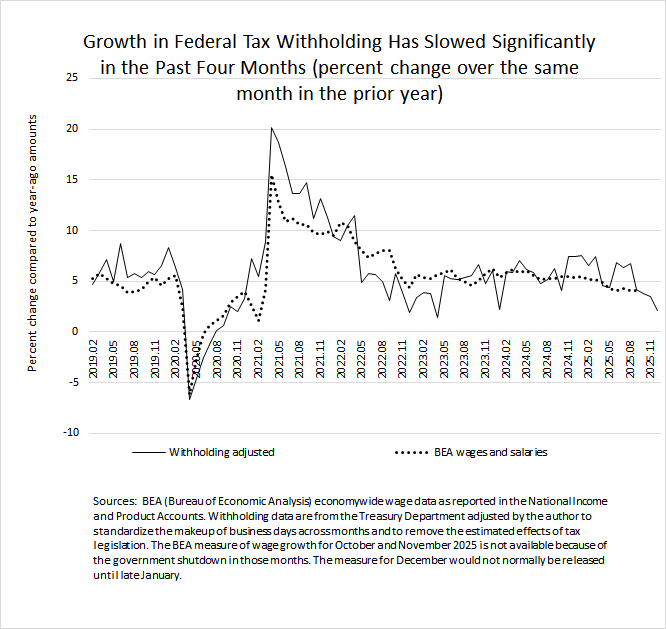
In December, we observed the fourth consecutive month with declining growth in federal tax withholding–amounts of income and payroll taxes withheld from workers’ paychecks by employers and remitted to the Treasury Department as soon as the day after the workers were paid. Specifically, we estimate that tax withholding grew by 2.1 percent in December compared to the amounts from December 2024, measuring so-called year-over-year growth (see the chart below). That amount of growth is lower than the rate of inflation, so that represents a decline in real (inflation-adjusted) terms. We estimate that withholding growth on a year-over-year basis was around 6 percent to 7 percent from June through August, then 4.2 percent in September, 3.8 percent in October, and 3.5 percent in November.
Although withholding growth has moved down in each of the past four months and was below the rate of inflation in December, there are a couple of reasons I hesitate to start using the recession word. First, December is an unusual month in that year-end bonuses can move wages and withholding around significantly, and those movements are not related to employment. Year-end bonuses can also significantly affect January withholding. Second the weakest growth, in December, is only one month’s worth of data. Withholding can be volatile from month to month. Nonetheless, I had expected a strong year-end bonus season based on activity in financial markets in 2025, and the continued move down in withholding growth in December is concerning.
We normally like to compare withholding growth with that of economywide wages and salaries. However, economywide wage and salary data from the Bureau of Economic Analysis (BEA), what we consider the best economywide wage and salary data normally released within a month of each month’s end, are currently delayed as a result of the federal government shutdown in October and the first part of November. Those data are currently available only through September. We expect that the wage data for October will not be available until additional quarterly reporting by states becomes available this spring–because the government employment report for October, the initial source of BEA’s wage data, is not available at all. The BEA release for November should be available much more quickly but is also delayed by the shutdown, and the release for December would not normally be available until late January, but may be delayed as well.