Posted on April 15, 2026
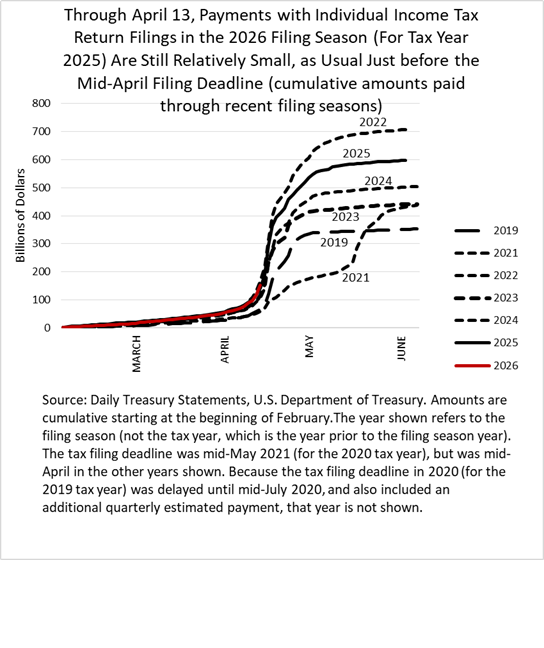
Today is the due date for filing federal income tax returns for the 2025 tax year. Payments with tax return filings, along with much smaller amounts paid as estimated tax for the first quarter of 2026, are thus due today. As usual at this point in the filing season, it is too early to see signs of how much will be paid. Amounts tabulated for the tax season since early February have risen rapidly in the past few days (see the chart below, the red line being this year), but amounts are still relatively small. In the past few years, around 20 percent to 25 percent of the full amount has typically been paid by now. Over the next few days, much will come to the IRS as electronic payments. But significant amounts will arrive at the IRS in the form of mailed checks. Those payments by check for timely-filed returns usually take the IRS two or three weeks to totally tabulate, and those amounts can surprise us until the end of the counting.
I expect to update that tracking chart on the taxtracking.com homepage on a near-daily basis through early May, with a blurb on what I am seeing.
So, what do I expect?
- This filing season I am expecting single digit percentage gains over last year’s amounts. But it is always very hard to predict the amounts of payments with tax return filings. Back in my government employee days working on that (a lot), there tended to be surprises more often than not. (Actually, I remember very few single-digit growth years. Payments with tax returns are quite volatile.)
- My expectation for a single digit percentage gain is the effect of two partially offsetting factors. First, there was a semi-boom stock market in 2025, with the S&P500, for example, up about 17 percent over the year, along with a strong Wall Street bonus season. Those events tend to boost payments with tax returns into double digit growth territory, sometimes more than 20 percent. I would translate a 17 percent stock market increase into perhaps a 15 percent growth in tax return payments–maybe a little more. Second, partially offsetting that first factor, there’s the 2025 Reconciliation legislation (also known as the One Big Beautiful Bill, though that name was officially removed from the final legislation). In that legislation, several tax reductions took effect for the full 2025 tax year, but without automatic changes in withholding or other forms of tax payments during the year. That is causing a hefty increase in tax refunds this filing season, and it should reduce payments with tax returns as well. Payments with tax returns are disproportionately from higher-income taxpayers, and the biggest legislative contributor to reducing payments with tax returns might be the significantly higher deductible amounts allowed for state and local taxes.
- We should get some indication of how payments are tracking next week after the bulk of payments made electronically are tabulated. But even then, we will have to wait for the tabulation of the amounts paid by check.
- I’m not expecting reduced staffing at the IRS, especially in enforcement activities, to have a big effect on revenues–yet. It should take time for that to become significant. But if IRS employment, which was cut substantially early last year, remains very low by historical standards, then the low-level of audits should continue. Even with technological improvements, it is hard to see how revenue from enforcement activities would not decline. And higher-income taxpayers, who pay most of the income taxes and have a smaller share of income tracked by information reporting, would have less and less concern about being audited. And that in turn would start the nation down the road to significantly less voluntary tax compliance.